
Get ahead of competitors with a strategic technology roadmap built around your business goals.
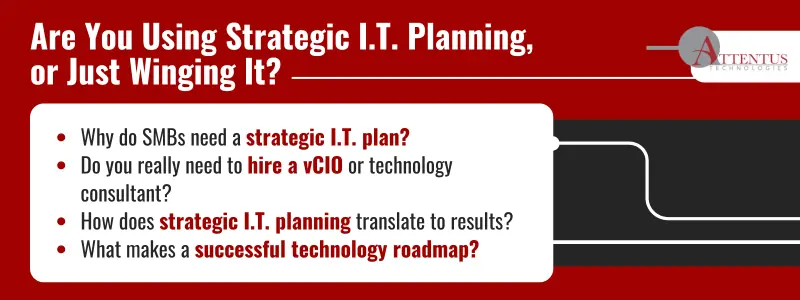
Wait for something to break. Patch it up. Move on.
It works for a while…
But here’s the truth: treating I.T. like an endless to-do list creates the illusion of progress whenever tickets close…yet it rarely moves the business forward. Strategic I.T. planning does.
If your I.T. strategy lives on a forgotten task list, are you truly leading your technology…or just reacting to whatever breaks next?
Today, many SMB leaders spend more time firefighting daily I.T. issues than setting long-term direction that prevents those issues from happening at all.
Strategic I.T. planning turns reactive chaos into predictable, continuous progress by aligning technology investments with business goals. And it’s exactly what you need to future-proof in 2026 and beyond. Here’s what to know.
What’s my action item? List your top five recurring I.T. pain points. If any appear more than twice, they aren’t technical issues: they’re strategic gaps that need addressing.
Why SMBs Need a Strategic I.T. Plan
Your technology was “good enough,” and you (probably) rarely experienced any problems with it during your early days as a startup…
Today, however, you’ve likely hired more staff, opened new locations, or introduced new products. Cracks are starting to show up in your I.T., which now feels like a battlefield.
Not a day goes by without another emergency or some disruptive event, and surprise costs continue to pile up rapidly.
You wonder: Why?
It’s because you outgrew your technology before realizing it.
And how did you get here?
You thought short-term. Not long-term.
I.T. strategy services allow you to plan what technology you’ll buy, when, and why, and tie those investments to business outcomes. Without a strategy, there’s no direction. And that translates (sooner or later) to wasted spend, missed opportunities, and constant interruptions.
That said, strategic I.T. planning can seem daunting, especially if it’s your first time even thinking about leveling up your infrastructure.
But it doesn’t have to be that way. Today, SMBs can partner with a Virtual Chief Information Officer (vCIO) to lead strategic technology management.
What’s my action item? Identify whether your tech projects are “urgent” or “important.” If 80% are urgent, your I.T. plan isn’t working.
The Role of a vCIO
So, who is a vCIO?
A vCIO is a senior technology leader who provides high-level strategic guidance without the cost of a full-time CIO.
They help prioritize critical initiatives, forecast costs, align I.T. to business outcomes, anticipate risks, and successfully scale your business.
For example, Attentus vCIO I.T. strategy services help SMBs create and implement 12-month technology roadmaps focused on growth, scalability, and security. This ensures you stay at the leading edge.
What makes vCIOs a compelling choice for SMBs is the value proposition: You get the same top-tier I.T. strategy services as large enterprises with full-time in-house CIOs, at a fraction of the cost.
(Curious? Request a quote today to see just how affordable vCIO services can be.)
What’s my action item? Ask your MSP: Do we have a defined roadmap that ties every technology investment to business results?
How Strategic I.T. Planning Translates Into Real Results
With strategic planning, I.T. stops being a cost center held together by quick fixes and becomes an engine that drives business performance.
Here’s how that shows up:
#1: Predictable Budgeting
By proactively planning your upgrades, licences, and refresh cycles, you’ll know exactly what expenses are coming down the road and never be blindsided by last-minute emergency costs.
#2: Improved Productivity
With strategic I.T. planning, you move away from duct-taped solutions to systems designed to support employees. There’s less frustration, fewer rounds of ticket tennis, and increased daily output.
#3: Risk Reduction
Data breaches now cost businesses an average of $4.44 million, according to IBM. Compliance violations can equally leave a dent on your wallet in terms of fines and penalties to pay.
With Strategic I.T. planning, you can better proactively stay ahead of security and compliance needs, and, therefore, avoid unnecessary negative impacts on your bottom line.
What’s my action item? Compare your current technology replacement schedule to your growth plan. Do they align?
Key Components of a Successful Technology Roadmap
When doing your strategic I.T. planning, make sure your technology roadmap includes the following:
- An Infrastructure Review: Map out your hardware and software assets. What’s mission-critical? Is anything obsolete?
- A Risk Assessment: What gaps exist in your current cybersecurity and compliance posture? How can you close them?
- Budget Alignment: Be sure to assign costs to business priorities, not just hardware.
- Growth Forecasting: Where will you be three to five years from now? You will likely add new hires, locations, or services, so factor those changes into your plan.
By being proactive, you will automatically eliminate the costs of reactive I.T.
What’s my action item? Schedule quarterly I.T. planning sessions instead of waiting for issues to trigger projects.
The Hidden Costs of “Reactive I.T.”
Here’s the truth people rarely talk about: Reactive I.T. drains budget in ways that rarely appear on the balance sheet.. And in the end, it can cost up to 3x more than preventing issues through strategic maintenance.
For example, when something breaks, you usually don’t just pay the direct cost of emergency fixes. Considerable productivity is lost as people wait for systems to come back. What about the leadership time diverted to manage a crisis that should never have happened?
If you’re spending so much time firefighting, will you have the capacity to create tomorrow’s competitive advantages?
Proactive and strategic I.T. planning is the way to go if you want to stay ahead of the digital curve.
What’s my action item? Track how much time your team spends on I.T. “fires” each month, then calculate that into lost productivity.
How Attentus Helps SMBs Get Strategic
Delivering tailored I.T. strategy services is challenging…but Attentus has done it for countless SMBs.
Our I.T. strategy services combine vCIO guidance, data analysis, and proactive support to build scalable technology plans. Here’s what you get:
- A comprehensive 12-month technology roadmap with clear priorities.
- Continuous monitoring to spot and resolve issues before they escalate.
- Quarterly reviews to update the roadmap as business needs evolve.
- True ownership and accountability.
In a nutshell, Attentus “owns the problem,” not just the ticket. Our clients get clarity, accountability, and proactive leadership.
What’s my action item? When evaluating MSPs, ask if they provide quarterly business reviews (QBRs) focused on outcomes, not uptime
Stop Managing Tasks. Lead With Strategic I.T. Planning.
I.T. shouldn’t be a list of problems to solve. It should be a strategic engine for growth.
If you’re tired of feeling buried under a never-ending to-do list, let’s talk about how to make real, predictable progress.
Book a strategic I.T. advisory session with Attentus and walk away with a clear 12-month roadmap, the top priorities you should act on first, and the accountability to make it happen.