
Waiting for systems to fail before acting isn’t just outdated…it’s like driving without a spare tire. Proactive budgeting is the new name of the game.
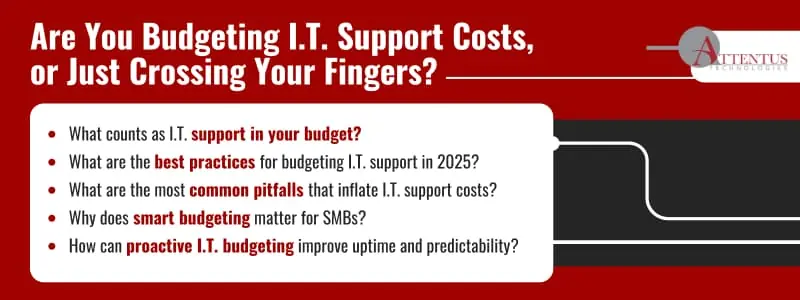
If your I.T. budget only covers what breaks, you’re paying for problems instead of preventing them.
It’s likely because you’re budgeting for firefighting instead of proactivity.
Here’s the truth: Treating I.T. support as a break-fix line item inevitably results in expensive downtime, lost productivity, and endless ticket tennis.
All these events are avoidable…
At Attentus, we’ve seen firsthand how proactive budgeting can reduce support costs by up to 40% by simply planning ahead. In 2025, budgeting for I.T. support costs means balancing help desk expenses with proactive management that prevents emergencies. And that’s exactly what smart SMB owners like you are doing.
Will you join them? If yes, then here’s all you need to know to flip the narrative.
What’s my action item? Compare last year’s emergency tickets against downtime costs. This shows where your real I.T. spend is going.
What Counts as I.T. Support in Your Budget?
First things first. What exactly are I.T. support costs?
In simple terms, it’s the money expended on configuring, implementing, and maintaining your I.T. infrastructure (including all hardware and software). It also covers help desk response and troubleshooting whenever there’s an issue.
The following sections explore steps to optimize your I.T. support costs and some of the mistakes you should avoid.
What’s my action item? Break your current MSP bill into buckets: support, proactive maintenance, and infrastructure.
3 Steps to Effectively Budget for I.T. Support Costs
Recent data shows that downtime for small businesses with about 20 employees and $5 million in annual revenue costs about $3,400 per hour.
Let’s break the I.T. support costs budgeting process down into simple steps.
Step #1: Evaluate How Your Business Uses Support
Start by asking these key questions:
- Do you plan to grow your business soon, and how will this impact support demand?
- Are responses quick, friendly, and effective in your current arrangement?
- How many tickets were generated vs. resolved in the last 12 months?
Reflecting on these will help accurately predict whether costs will go up, as well as whether you’re getting a fair value for your investment. It can also shed light on whether you’re overrelying on help desk support.
What’s my action item? Track monthly support tickets by type. Recurring issues = a lack of proactive management.
Step #2: Analyze Your True Costs
Next, it’s time to analyze your responses to the questions above.
What’s That Growth Actually Going to Cost?
Business growth translates to more employees and endpoints, which increases your demand for I.T. support, and by extension, total costs.
Based on historical expenses, what should you expect to spend now that you’re expanding?
How Much Money Goes Down the Drain Because of Poor Service Quality?
How effective would you say your current I.T. support service ranks on a scale of one to 10? Remember, a slow or ineffective help desk means higher downtime.
And that, too, is a cost in terms of lost business and productivity.
What’s the Relative Cost of Being Reactive Instead of proactive
Generally, frequent tickets reveal an expensive “whack-a-mole” approach. It means your business is in firefighting mode most of the time.
How much could you save if you could reduce or eliminate issues? That’s the price of being reactive.
Read more: Reactive and Proactive I.T. Explained.
What’s my action item? Calculate “cost per resolved ticket” including lost employee hours, not just MSP fees.
Step #3: Work With Your MSP to Optimize Costs
Playing ticket tennis is no fun. It wastes both employee and technician time. That’s where this final step comes in handy. Engage your managed service budget partner to shift the focus from tickets to root-cause elimination.
Ensure they’re regularly doing preventative maintenance and system monitoring to reduce your reliance on help desk intervention.
What’s my action item? Ask your MSP to provide a quarterly report on prevented incidents (not just resolved ones).
Best Practices for Budgeting I.T. Support in 2025
Here’s how successful SMBs approach their 2025 I.T. budgets:
- Forecast with growth in mind. Budget support per endpoint and plan for team expansion.
- Use a mix of services. Don’t settle for just a help desk service. Ensure proactive maintenance and monitoring are also baked into your I.T. support strategy.
- Align I.T. support with business goals to ensure it enables, not delays, productivity.
What’s my action item? Include proactive services as a fixed budget line item. If your MSP doesn’t provide this, you’re underfunding future stability.
Common Pitfalls That Inflate I.T. Support Costs
So, what costly mistakes do SMBs make regarding I.T. support?
- Relying only on reactive support (no prevention).
- Not tracking ticket volume or types.
- Choosing the cheapest MSP option without measuring value.
- Ignoring the indirect costs of downtime (lost deals, reputation hits).
Avoiding these considerably reduces your total spend.
What’s my action item? Review the last 6 months of I.T. incidents. How many could have been prevented with proactive monitoring?
Why Does Smart Budgeting Matter for SMBs?
It’s simple. Poor budgeting translates to rising costs, wasted staff hours, and customer dissatisfaction.
Smart budgeting transforms I.T. from a cost center into a competitive advantage. Generally, SMBs that combine support with proactive planning see fewer surprises and stronger ROI.
What’s my action item? Build your 2025 I.T. budget around managed services that reduce tickets, not just answer them.
Don’t Let Ticket Tennis Drain Your Budget. Get Proactive with Attentus!
Effective I.T. budgeting isn’t about buying more support. It’s about reducing the need for it.
At Attentus, we believe support should be the last line of defense, not the first. That’s why we take proactive care to keep our managed service budget costs predictable and downtime rare.
Ready to rethink your I.T. support costs?
Let Attentus help you turn unpredictable ticket chaos into a stable, proactive support budget.