
Most businesses invest in technology without a strategy to guide it, leaving growth, security, and efficiency on the table. A virtual CIO turns I.T. into a leadership function that drives smarter decisions, stronger resilience, and long-term operational maturity.
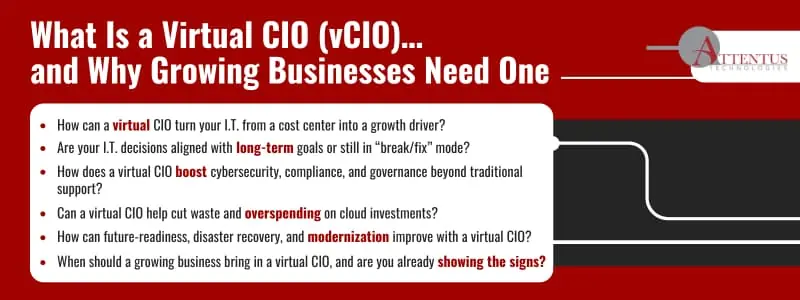
Are you confident that your technology is actually supporting your business, or does it feel like something’s missing?
The truth is that many growing SMBs sit somewhere in the middle. The systems work, the support provider responds to issues, and nothing seems urgently wrong.
But even with everything “working,” the business may not feel like it’s truly moving forward. That “missing” feeling usually comes from a lack of strategic I.T. direction, not a lack of tools.
And the numbers back it up: According to Statista, small businesses spend an average of 4% of their revenue on technology each year, yet most of that investment is not tied to strategy or long-term value. It’s reactive spending that fixes today’s issues while leaving tomorrow’s needs unclear.
A virtual CIO helps close that gap. Instead of hiring a full-time executive, you gain strategic I.T. leadership that aligns your technology with your business goals at a smaller cost (while also ensuring your business’s I.T. function is code-compliant).
It turns I.T. from something you “manage” into something that drives progress, providing your organization with clarity, planning, and confident decision-making without the technical overwhelm.
Think of it this way: Traditional I.T. providers keep things running. A virtual CIO helps your organization grow with intention.
What a Virtual CIO Actually Does
A virtual CIO provides outsourced I.T. leadership and long-term direction. They constantly ask questions, anticipate problems, and uncover issues that have likely been buried for too long.
Their role is to build and manage a technology strategy that supports where the business is going, not just what it needs today. A strong virtual CIO brings structure, clarity, and forward planning by focusing on:
- Strategic I.T. planning and budgeting: Defining the path ahead and making sure your technology can support it.
- Risk assessment and cybersecurity oversight: Spotting vulnerabilities early and strengthening protection across the organization.
- Vendor management and contract negotiation: Acting as your advocate so you get real value, performance, and accountability.
- Technology roadmap creation: Guiding modernization in a way that avoids overspending and unnecessary disruption.
- Performance metrics and KPI alignment: Turning technology outcomes into measurable improvements that leaders can track.
With this kind of guidance, your leadership team gains clarity, your operations run with more consistency, and your people work with the confidence that the I.T. foundation beneath them is reliable and built for the future.
What’s my action item? If your I.T. conversations focus on “what’s broken” instead of “what’s next,” it’s a strong sign that you need virtual CIO leadership.
Turning I.T. from a Cost Center to a Growth Driver
Many small and mid-sized businesses still treat I.T. as overhead, something they must simply pay for to “get by” rather than something that moves the business forward.
A virtual CIO changes that perspective by leveraging technology to drive productivity, competitiveness, and long-term scalability.
And this shift can show up in several practical ways:
- Automation that cuts down repetitive work and frees up staff capacity.
- Data analytics that help leaders make faster, clearer decisions.
- Workflows and integrations that remove bottlenecks and improve daily operations.
- Cloud optimization that reduces unnecessary spend without sacrificing capability.
Here’s the reality many businesses overlook: 94% of enterprises report overspending on cloud services, often due to unused resources or a lack of forecasting. A virtual CIO helps avoid this problem by ensuring every investment has a purpose and directly supports your operational goals.
What’s my action item? Ask your provider whether your current technology strategy supports your top three business objectives. If the answer is no, your I.T. is likely holding your business back.
How a vCIO Strengthens Cybersecurity and Compliance
In the past, security issues were seen as reactive technical problems that the I.T. department handled quietly in the background.
That mindset no longer works. Security has shifted into a board-level concern that affects reputation, customer trust, revenue, and even leadership accountability.
A virtual CIO makes sure cybersecurity is part of every strategic decision, not an afterthought.
Their work often includes:
- Vulnerability assessments that uncover weak points before attackers do.
- Layered protection strategies based on your actual risk profile.
- Security awareness training that strengthens your first line of defense.
- Compliance oversight to meet legal, regulatory, and industry requirements.
- Incident planning and governance that reduce disruption and confusion.
Modern cybersecurity is less about responding to fear and more about leading with clarity. It creates a culture where people understand their role in protecting the business and where decisions are guided by preparation rather than panic.
Actionable Takeaway: A virtual CIO establishes the governance structure that most small and mid-sized businesses do not realize they need until after an incident occurs.
Budgeting with Confidence: Predictable I.T. Costs
Without a strategic leader guiding the process, I.T. budgeting often turns into guesswork. Costs appear out of nowhere, projects grow beyond expectations, and leadership ends up reacting instead of planning.
A virtual CIO brings structure to this chaos by creating annual I.T. budgets based on real operational needs and by tracking ROI for every major technology investment.
A virtual CIO also introduces lifecycle planning so hardware, software, and systems are replaced before they fail, not after.
They use forecasting to prepare for growth, new locations, and future tools. This is the core of strategic I.T. leadership: giving business owners a predictable roadmap so they can invest confidently and allocate resources with purpose.
Actionable Takeaway: A strategic I.T. budget eliminates crisis spending and ensures every dollar contributes to stability, continuity, and long-term growth.
Building Agility and Future-Readiness
Technology should never sit still, and neither should your business. A virtual CIO keeps your infrastructure, tools, and processes evolving at the same pace as your goals with:
- Cloud scalability and modernization.
- Disaster recovery and business continuity planning.
- Evaluating new technologies that improve customer experience or efficiency.
- Reviewing legacy systems to determine what should stay, improve, or retire.
Strong technology strategy solves today’s problems while preparing for tomorrow’s challenges.
For business leaders, this means fewer surprises, clearer planning, and a culture that embraces innovation instead of scrambling during disruptions.
Actionable Takeaway: Future-proofing your technology protects both your revenue and your reputation.
Partnering for Long-Term Success
Attentus takes a relationship-first approach to vCIO services. We do not see ourselves as a vendor. Instead, we operate as an extension of your leadership team.
Our virtual CIOs:
- Align I.T. decisions with core business goals.
- Own the problem from beginning to end.
- Maintain transparency and accountability.
- Work across departments to eliminate silos.
- Build long-term strategies that support real, measurable growth.
The focus is not on selling tools. It is on building a healthier, more resilient organization one decision at a time.
Actionable Takeaway: The right virtual CIO is not reactive. They become a proactive partner focused on growth, clarity, and long-term success.
When to Bring in a vCIO
The good news is that you don’t need a crisis to justify strategic I.T. leadership. Most small and mid-sized businesses bring in a virtual CIO when they start experiencing:
- Rapid growth or multi-location expansion.
- Leaders overwhelmed by technology decisions.
- Increasing cybersecurity and compliance demands.
- Outdated, inconsistent, or undocumented I.T. processes.
- No clear roadmap for the next 12 to 36 months.
- Difficulty managing vendors or holding them accountable.
If technology decisions are slowing you down, creating uncertainty, or forcing guesswork, it’s time to bring in strategic leadership.
Actionable Takeaway: When your business is scaling faster than your I.T. strategy, virtual CIO leadership becomes essential, not optional.
Strategic I.T. Leadership for Every Business Size
A virtual CIO brings the vision, planning, and leadership of a full-time CIO at a fraction of the cost.
For a growing business, this means you can innovate, modernize, and strengthen your organization without stretching your budget or overloading your internal staff. It gives you the strategic support you need to grow with intention rather than react to challenges as they arise.
At Attentus, we believe strong technology leadership is built on clarity and planning. It looks ahead, not backward. It focuses on measurable outcomes and long-term partnership, not quick fixes. When your strategy is intentional, your I.T. becomes a foundation for stability, efficiency, and growth.
Ready to align your technology with your business goals? Partner with Attentus and access a dedicated virtual CIO who keeps your I.T. strategy, and your business, future-ready.