
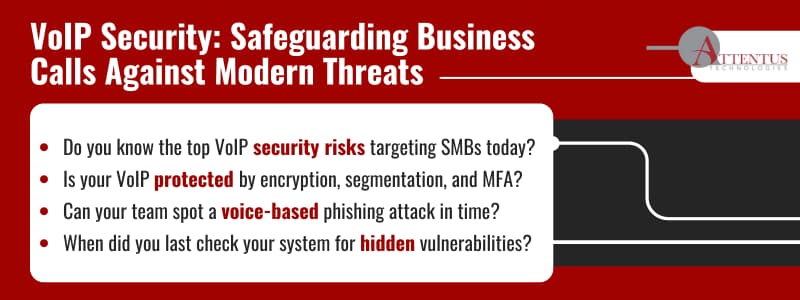
Would your team recognize a voice-based phishing attack before it’s too late? Social engineering through VoIP is one of the fastest-growing threats…and it only takes one call to compromise your network.
Did you know that the vast majority of cyberattacks targeting small- and mid-sized businesses (SMBs) exploit weak communication systems as an entry point?
In fact, one study found that 94% of SMBs experienced at least one cyberattack in the last year alone.
The results? Irritated employees, operational disruption, regulatory risk, and reputational damage.
As more organizations rely on Voice over Internet Protocol (VoIP) for daily communication, the risks associated with it are also increasing.
VoIP allows calls, video meetings, and messages to travel through the same internet networks that power your business, which means a single vulnerability could expose everything from confidential conversations to customer data.
That’s why, in this article, we’ll explore in detail the most significant VoIP threats, their solutions, and the best VoIP security practices your business should adopt to remain secure, compliant, and focused on growth.
(Want to skip the reading and get straight to a free VoIP security audit? Feel free to get in touch.)
Why VoIP Security Matters More Than Ever
Voice calls and data flows now ride the same networks as your most critical business systems.
That makes VoIP security threats particularly damaging: poor call encryption or weak infrastructure can allow eavesdropping, toll fraud, spoofing, or full-scale denial-of-service attacks.
Consider this: if your VoIP platform is compromised, a hacker might not just listen…they might make calls, impersonate your number, or disrupt your communications entirely. And while your default response might be “our provider handles everything,” the reality is that you’re ultimately responsible for ensuring the security of your own network and endpoints.
What’s my action item? Request a comprehensive review of your current hosted voice platform’s security posture, including encryption, intrusion detection, call-fraud alerts, and the segregation of voice traffic. If you don’t have documentation, you’re already at risk.
The Role of VoIP Encryption in Data Protection
When calls and messages travel unencrypted, they’re effectively open to interception and misuse.
Implementing VoIP call encryption using protocols such as SRTP (Secure Real-Time Transport Protocol) and TLS (Transport Layer Security) ensures that your voice traffic remains confidential and secure.
Encryption also helps meet VoIP compliance requirements for industries such as legal, finance, and healthcare, where voice may carry regulated data.
A notable fact: reports indicate that 78% of businesses view VoIP as more secure than traditional phone systems when properly managed.
What’s my action item? Verify end-to-end encryption is in place for all voice traffic, and document the encryption protocols your provider uses. If only partial or optional VoIP encryption is available, consider upgrading to a secure business VoIP solution for enhanced security.
Common VoIP Security Threats Facing Businesses
Here are several key VoIP security threats that you should know:
- Eavesdropping: Unencrypted voice traffic enables malicious actors to intercept and listen in.
- Vishing (voice phishing): Attackers use VoIP to impersonate trusted callers and manipulate staff members.
- Toll fraud: Unauthorized use of your system to make expensive long-distance calls.
- Caller ID spoofing: Attackers make calls that appear to come from trusted internal or external numbers.
- Voicemail hacking: Weak authentication on voicemail systems allows attackers to access sensitive messages.
- DoS/DDoS attacks on VoIP infrastructure: Overload your voice network, disrupting calls and business continuity.
To mitigate this, you’ll want VoIP firewall protection and log monitoring specifically designed for voice traffic. Tight access controls and segmentation (isolating voice from other network traffic) go a long way toward reducing risk.
What’s my action item? Run regular reviews of your call logs to identify unusual patterns, such as large volumes of international calls, calls made at unusual hours, or unfamiliar devices accessing your system.
Ensure that your firewall and anti-fraud tools are configured to defend against VoIP threats.
Building a Secure VoIP Network Foundation
Strong VoIP network security isn’t just about the phone system but about your entire network infrastructure.
Here’s where to start:
- Network segmentation: Keep voice traffic on its own VLAN or subnet to reduce exposure if another part of the network is compromised.
- Patch and firmware hygiene: Ensure all VoIP phones, gateways, and servers are up to date, as unpatched systems are a common point of compromise.
- Multi-factor authentication (MFA): Require MFA for all administrative access to your VoIP platform to prevent attackers from assuming control via stolen credentials.
- VPNs or secure tunnels for remote workers: If staff use VoIP over remote connections, ensure you have secure tunnels protecting voice traffic from interception, especially on public WiFi.
What’s my action item? Map out devices, access points, and traffic flows associated with your VoIP platform this week. Are they isolated? Are updates current? If not, you have work to do.
Ongoing VoIP vulnerability management
VoIP vulnerability management is not a “set it and forget it” project. Threat actors constantly evolve, and so, here’s what modern SMBs should include:
- Set up automated patch management for VoIP systems and related network gear.
- Schedule annual or semi-annual penetration tests or vulnerability scans specifically targeting your voice infrastructure.
- Ensure your managed-services provider (or in-house team) includes real-time monitoring and reporting on voice traffic, call volume anomalies, and intrusion attempts.
- Maintain documentation and logs that demonstrate your system meets regulatory standards, particularly if your business handles sensitive data.
What’s my action item? Ask your provider this month for the most recent audit or scan of your voice network, and when the next one is scheduled. If they don’t always do one, change providers.
VoIP Security Best Practices for Modern SMBs
Modern SMBs depend on VoIP for seamless communication, but growing cyber threats make security a top priority.
Below are essential VoIP security best practices to protect your network, data, and business reputation.
- Enforce strong, unique passwords for all VoIP devices and system access.
- Ensure end-to-end encryption (call and signaling) is enabled across your system.
- Keep firmware, software, and hardware up to date across all devices and systems.
- Apply MFA for access to your phone system, portals, and admin accounts.
- Train employees on vishing, caller-ID spoofing, and voice-based social engineering.
- Regularly check call logs, system access logs, and use fraud detection tools.
- Establish monitoring and alerting for suspicious voice traffic patterns (e.g., many international calls, unknown endpoints).
- Work with an MSP or provider that offers hosted VoIP security, audit reports, and a documented shared-responsibility model.
What’s my action item? Choose one item from the list above and commit to completing it within the next week. Small steps build a robust defense.
Protect your voice infrastructure with Attentus VoIP security
For many SMBs, communication is the lifeblood of their operations. Yet far too often, voice systems are treated as an afterthought, until something breaks or worse, someone listens.
With VoIP security and VoIP encryption properly implemented, you’re protecting calls, safeguarding your reputation, your data, and the trust your clients place in you.
At Attentus Technologies, one of our core values is accountability. We don’t wait for issues to happen. We monitor, patch, plan, and proactively defend, so your voice infrastructure supports your goals, uninterrupted.
If you’re ready to upgrade your voice communications from a risk to a strength, we’re prepared to help.