
If billion-dollar companies can be breached, small businesses should never assume they’re invisible. Here’s what actually happens to stolen business data…and how SMBs can reduce the risk before it leaves their control.
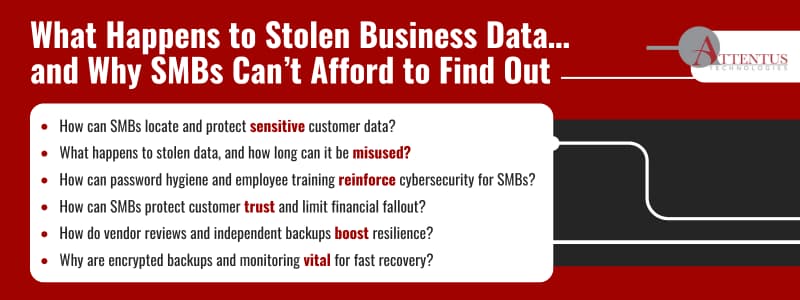
How does a billion-dollar company with full-time security teams still end up getting its data stolen by hackers?
In November 2025, SitusAMC, a billion-dollar real estate services provider, confirmed that data from client and customer accounts had been stolen from its systems.
Accounting records, legal agreements, and sensitive customer information were compromised. There was no ransomware and no operational downtime—just silent data theft with long-term consequences that may surface months or years later.
For many small and mid-sized businesses, stories like this trigger the same uneasy question: If a billion-dollar enterprise with advanced defenses can be breached, where does that leave us?
Yet, many SMB leaders still assume they’re “too small to target.” The data consistently proves otherwise. According to the 2025 Verizon Data Breach Investigations Report (DBIR), 58% of breach victims in 2024 were small or mid-sized businesses, not global brands.
The real danger isn’t only in the breach itself. It’s in what happens after your stolen data enters criminal ecosystems.
Once it leaves your network, the ripple effects can break trust, disrupt operations, and force small teams into survival mode.
This is where leadership and culture come into play. Protecting customer information is not just an IT function…it is a core business value and a leadership responsibility.
Actionable takeaway: If you don’t know where your customer data lives or how it’s protected, you’re already at risk.
What happens to stolen business data?
When business data is stolen, it enters a predictable (and very human) chain reaction, even though the mechanics unfold quietly behind screens.
#1. Immediate Sale
Within hours, stolen data is listed on dark-web marketplaces. Customer records, contracts, financial details, and login credentials are bundled and sold in bulk.
Criminal buyers use the information for identity theft, fraud, and extortion. The entire cycle is fast, anonymous, and profitable.
#2. Credential Stuffing & Target Expansion
One stolen email and password can unlock many systems. Attackers test the same credentials across banking apps, payroll platforms, vendor portals, and cloud accounts.
Since 62% of people still reuse passwords, intruders often move quietly from one system to another.
This is not only a technical issue. It is a leadership and culture issue. Password habits directly reflect workplace expectations and enforcement.
#3. Ransom or Reputation Leverage
Even without encrypting anything, criminals often reach out directly:
- Pay us, or the data goes public.
- Pay us, or your customers will receive it first.
Sometimes they impersonate your business using the same stolen data, contacting customers or partners with frightening accuracy.
#4. Long-Tail Consequences
Business records do not expire. Once uploaded, stolen information is repackaged, resold, and reused for years.
Criminal groups treat it as a renewable asset, not a one-time win. A slow or weak data breach response makes this cycle even worse.
Actionable takeaway: Once customer data leaves your control, you never get it back. Prevention and fast containment are your only real defenses.
Why SMBS Suffer the Most After a Data Breach
Large firms like SitusAMC can hire crisis-communication agencies, legal teams, and global incident responders. SMBs can’t. For smaller organizations, the fallout hits harder:
#1. Loss of Customer Trust
A 2024 study found that 70% of consumers stop doing business with a company after a breach. For SMBs, trust is not a brand accessory: It’s the foundation of the entire industry.
#2. Financial Impact
According to IBM’s 2025 Cost of a Data Breach Report, the global average cost of an SMB breach has reached $4.4 million.
Insurance may cover some expenses, but it cannot repair customer confidence or prevent churn.
#3. Operational Disruption
A breach pulls small teams away from their priorities. Leaders step out of strategic work and into crisis mode.
Downtime, compliance reporting, and partner notifications can overwhelm already stretched resources.
The leadership lesson is simple. When security is viewed as only an I.T. responsibility, the organization develops a blind spot that becomes expensive to correct.
Actionable takeaway: The cost of prevention is far lower than the cost of recovery, and recovery does not guarantee customer loyalty.
Lessons From the SitusAMC and Cloudflare Incidents
The SitusAMC breach showed that even companies working with the world’s biggest banks can lose control of sensitive information.
Cloudflare’s November outage proved how a single service disruption can instantly affect thousands of smaller businesses that rely on its infrastructure.
Together, these incidents highlight a simple truth. Your security is only as strong as the partners, platforms, and vendors your business depends on.
Many SMBs never formalize vendor security reviews. Even fewer ask providers how they back up customer data or how they would respond in the event of a breach.
Yet, when your accounting system, payroll platform, CRM, or loan-processing tool goes offline, your business slows down with it.
This is why cybersecurity for SMBs is larger than firewalls or antivirus software. It is a question of leadership maturity, operational awareness, and resilience.
Actionable takeaway: SMBs should require vendor security reviews, independent backups, and clear continuity plans.
How to Keep Your Data Out of the Wrong Hands
Even small changes can yield significant protection gains.
Here’s what modern cybersecurity for SMBs looks like in practical terms:
A. Encrypt and Segment Everything
When data is encrypted, it becomes far less valuable to attackers. Encryption at rest and in transit protects stored files, emails, and cloud data.
Segmentation limits how far an intruder can move inside your network. One compromised device should never expose the entire business.
B. Train Employees Against Phishing
Human error drives most breaches. A 2024 Mimecast analysis found that 95% of incidents involved simple user mistakes, such as clicking a phishing link or mishandling credentials.
Training should focus on everyday awareness, not technical skill. Short simulations help teams slow down, verify requests, and report anything suspicious. Culture reduces risk long before software does.
C. Backups Are Not Optional
Encrypted, off-site backups allow a business to recover quickly, even after a ransomware incident.
Therefore, having data backups is not just a technical precaution. The strategy should be a core part of any effective data breach response plan.
D. Monitor and Patch Continuously
Real-time monitoring helps identify unusual activity before it becomes a crisis. Routine patching closes the vulnerabilities that attackers exploit.
For leaders, the real power lies in building consistency into these habits, not in chasing new tools.
SMBs that succeed in cybersecurity do not focus on every new product that hits the market. They build security into everyday routines and reinforce it through clear expectations and team culture.
Actionable takeaway: Your cybersecurity strategy should assume a breach will happen and be built around how quickly you can detect and contain it.
The “No-Fail Mission” of Customer Data Protection
Customers trust you with information that represents their livelihoods. One exposure can harm a brand, strain partnerships, and weaken community confidence, even when the response is handled correctly.
At Attentus, the belief is simple. Data security is not an I.T. feature. It is a leadership value that shapes culture, workflow, and decision-making. When leaders treat security as a shared responsibility, teams follow that example.
Actionable takeaway: Protecting customer data is not only about compliance. It is about credibility and the trust your business stands on.
Take a Stand. Security Is Everyone’s Business
SMBs need to approach customer data protection the same way large enterprises do. Preventing a breach is manageable and cost-effective. Recovering from one can threaten the entire business. Attentus helps organizations build practical, everyday security habits that keep data safe.
One of our core values is “be the solution,” and we exercise that in practice through proactivity, not a reactive, break-fix mentality.
Our team works with clients to implement robust safeguards, including MFA, endpoint protection, and encryption. We help create and test incident response plans so teams know precisely what to do under pressure.
We also train staff to recognize scams, phishing attempts, and other real-world threats. Effective security grows when the whole workplace understands its role.
Don’t wait until your company appears in the news for the wrong reasons. Reach out to Attentus for a proactive security assessment and learn how to strengthen cybersecurity for SMBs, protect customer information, and safeguard your reputation.