


If your IT systems feel reactive instead of proactive, there is a way to fix it. Many growing organizations face the same challenge. Broken workflows cost more than patience. 80% of employees lose significant productive hours monthly, and 42% of businesses lose money.
When IT isn’t aligned with operations, the consequences stack up quickly, rising costs, lagging systems, and teams stuck troubleshooting the same problems instead of driving innovation.
To understand why this happens so often, consider the common symptoms of low IT maturity:
-
Frequent downtime or recurring technical issues
-
Lack of standard processes across teams
-
Technology investments that don’t match business goals
-
Limited visibility into system performance
-
IT teams overwhelmed by reactive tasks
As Daniel Colon, Dir. of Managed Services, puts it, “Every IT system tells a story about a business. Reading it correctly transforms risk into opportunity and growth.” That’s exactly what an IT maturity assessment helps you do.
An IT maturity assessment reveals where your technology is holding you back and how well your IT strategy aligns with your business priorities. It evaluates everything from infrastructure and cybersecurity to workforce skills and process consistency.
With this clarity, you can make precise decisions that improve operational efficiency and eliminate guesswork. By the end of the assessment, you’ll know which areas require immediate attention and which are ready to scale. This becomes the foundation for a strong, future‑focused IT strategy, one that supports long‑term success and positions your business to grow with confidence.
Know Where Your I.T. Stands
Get a clear view of your I.T. maturity. Spot weak points early and build systems that support how you actually work.
How an IT Maturity Model Guides Your Business
An IT maturity model gives organizations a structured way to understand how effectively their IT environment operates. It evaluates processes, infrastructure, workforce skills, and strategic alignment, offering a practical, evidence‑based view of performance.
To see why this matters, consider what the model uncovers inside most organizations:
-
Gaps in service delivery that affect employee productivity
-
Weak or inconsistent cybersecurity practices
-
Outdated infrastructure slowing operations
-
Skills or resource shortages within IT teams
-
Misalignment between IT investments and business goals
By mapping systems and processes against defined maturity levels, businesses can pinpoint exactly which services need refinement. This clarity leads to fewer recurring issues, stronger workflows, and measurable productivity gains.
Organizations that regularly assess their IT maturity consistently see improvements because technology becomes an enabler.
When applied correctly, the IT maturity model ties IT operations directly to business outcomes. Every technology investment is backed by data, aligned with strategic objectives, and designed to support long‑term growth. It becomes a foundation for efficiency, reliability, and sustainable innovation.
Key Questions for a Successful IT Maturity Assessment
Every effective IT maturity assessment starts with the right questions—questions that expose operational gaps, uncover inefficiencies, and highlight opportunities for improvement. These areas form the backbone of a strong, future‑ready IT strategy.
To guide your evaluation, focus on these essential categories:
1. Management Alignment
Are your IT investments aligned with business goals? When technology and strategy drift apart, organizations waste resources and limit growth potential. An assessment determines whether each IT initiative supports revenue, efficiency, or competitive advantage.
2. Workforce Skills
Critical talent gaps will affect 90% of enterprises by 2026, with AI-related shortages jeopardizing $5.5 trillion in economic value.
Does your staff have the knowledge to fully use IT systems? Skill gaps slow adoption and create avoidable issues. Evaluating digital literacy, including software proficiency and data handling, helps identify where training or support is needed.
3. Technology Integration
Are your applications and infrastructure effectively connected? Fragmented systems increase error rates and reduce productivity. An assessment reviews network interdependencies, cloud integration, and ERP usage to pinpoint where systems fail to communicate.
4. Service Delivery
Are IT requests handled consistently? Slow response times frustrate users and disrupt workflows. Examining service ticket patterns, resolution times, and satisfaction scores reveals how well your IT team supports daily operations.
5. Cybersecurity Posture
Are your IT systems protected from threats? Cybersecurity maturity is a core component of IT maturity. Reviewing controls, monitoring practices, and staff training helps reduce risk exposure and strengthen resilience.
Answering these questions provides clear, actionable insights. You’ll understand what needs immediate attention and where long‑term investment will deliver the greatest impact.
Each question ties directly to operational efficiency, strategic alignment, and sustainable business growth.
Using a Business Process Maturity Assessment to Improve IT Operations
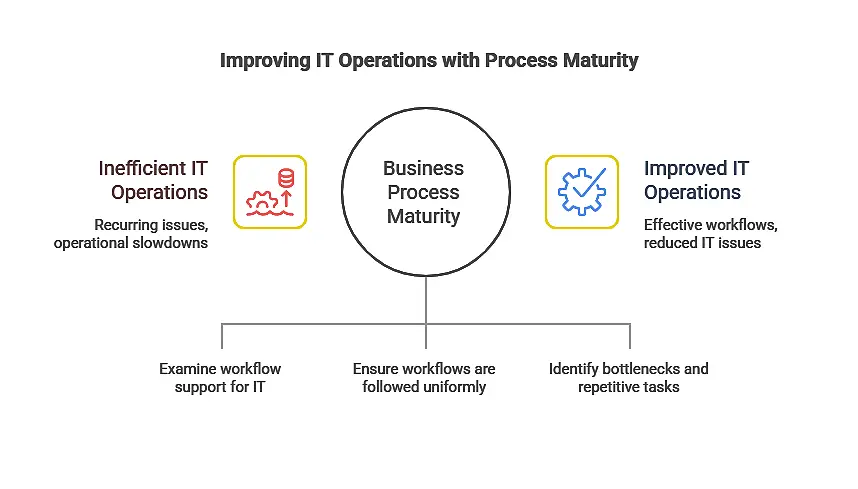
A business process maturity model helps organizations evaluate how effectively their workflows support IT systems and broader business objectives. By examining process structure, consistency, and efficiency, it becomes easier to identify the root causes of recurring IT issues and operational slowdowns.
To understand the value of this approach, consider the types of inefficiencies it uncovers:
-
Manual steps that delay updates or patch deployments
-
Unclear responsibilities that lead to duplicated work
-
Bottlenecks in approval chains or escalation paths
-
Repetitive tasks that drain staff time and energy
A process maturity assessment maps these workflows clearly, revealing where improvements are needed. When organizations refine their processes, productivity rises, staff spend less time on repetitive tasks and more time on strategic, value‑adding work.
It also strengthens IT service delivery, enabling teams to respond faster and more consistently to user requests.
A practical example illustrates this well: if your ticket escalation process is inconsistent, recurring issues multiply because problems aren’t routed or resolved efficiently.
A maturity assessment exposes these bottlenecks, allowing you to redesign workflows for faster resolution and smoother operations.
ITIL Maturity Model and IT Service Management Maturity Model
Frameworks like the ITIL maturity model and the IT service management (ITSM) maturity model evaluate how well your IT services support business needs. They measure everything from incident response to service delivery, offering clear benchmarks for improvement.
These models help organizations strengthen ITSM by highlighting gaps in:
-
Procedures and documentation
-
Policies and governance
-
Tools and automation
-
Service consistency and performance
By using these frameworks, businesses shift from reactive problem‑solving to proactive IT management. Regular review cycles make this possible:
-
Daily helpdesk reviews ensure consistent ticket handling
-
Monthly system audits identify emerging risks
-
Quarterly executive reviews align IT operations with business strategy
This structured approach improves service quality, enhances cybersecurity readiness, and supports better resource planning.
Organizations that adopt ITIL and ITSM maturity models experience fewer disruptions, stronger operational alignment, and a more resilient IT environment that supports long‑term growth.
More articles you might like:
Steps to Conduct an IT Maturity Assessment
A structured approach ensures your IT maturity assessment delivers meaningful, actionable insights. Each step builds on the last, giving you a clear picture of how well your technology supports your business.
To guide the process effectively, focus on these core activities:
-
Inventory IT systems and resources :Start by listing all hardware, software, cloud services, and integrations. This establishes a baseline and reveals redundancies, outdated tools, or unsupported systems.
-
Evaluate alignment with business objectives: Map each technology investment to revenue streams, operational needs, and compliance requirements. This step highlights whether IT spending supports strategic goals or needs recalibration.
-
Review workforce digital skills: Identify gaps in technical knowledge, software proficiency, and cybersecurity awareness. Skill mismatches often cause slow adoption, errors, and recurring support requests.
-
Map IT processes and workflow maturity: Examine service delivery, incident response, escalation paths, and recurring issue patterns. Mature processes reduce friction and improve consistency across teams.
-
Assess cybersecurity and compliance readiness: Evaluate controls, monitoring practices, and alignment with frameworks like NIST. This ensures your organization can withstand threats and meet regulatory expectations.
After completing the assessment, create clear, actionable reports. Share them with both IT and business stakeholders, outlining strengths, gaps, and a prioritized roadmap for remediation. This transparency helps leadership invest confidently in improvements that drive long‑term value.
Benefits of a Strong IT Maturity Assessment
A well‑executed IT maturity assessment delivers measurable improvements across your organization. It transforms IT from a reactive support function into a strategic driver of growth.
These benefits become clear as maturity increases:
-
Improved operational efficiency: Refined processes eliminate bottlenecks, reduce manual work, and free resources for higher‑value tasks.
-
Better IT service delivery: Users experience faster response times, fewer delays, and more reliable support.
-
Fewer recurring IT issues: Root causes are identified and resolved, preventing repeated downtime and frustration.
-
Stronger cybersecurity posture: Just 5% of business owners feel truly protected from cyber-attacks. Gaps are uncovered early and addressed proactively, reducing risk exposure.
-
Clear roadmap for growth: Technology investments align with strategic objectives, ensuring IT supports long‑term business goals.
Each benefit strengthens overall performance. With a strong IT maturity assessment, technology becomes a catalyst for innovation, efficiency, and sustainable growth.
Connecting IT Maturity to Business Strategy
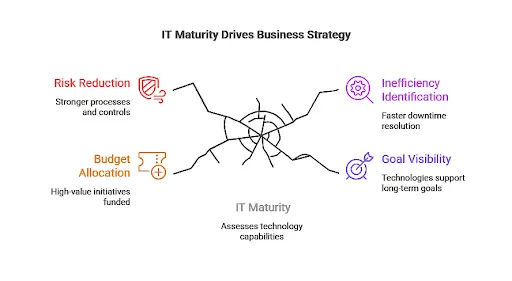 83% of companies say their tech is falling behind their growing demands. A strong IT maturity assessment creates a direct bridge between technology decisions and business outcomes. Instead of guessing where to invest, leaders gain clarity on which areas deliver the highest impact and which systems need immediate attention.
To see how this connection drives value, consider the types of improvements maturity insights unlock:
-
Better allocation of IT budgets toward high‑value initiatives
-
Reduced operational risk through stronger processes and controls
-
Faster identification of inefficiencies that cause recurring downtime
-
Clear visibility into which technologies support long‑term goals
When decisions are grounded in assessment data, organizations save costs, reduce risk exposure, and future‑proof their operations.
For example, uncovering inefficient workflows can eliminate hours of downtime each month. A well‑defined IT roadmap also supports confident scaling and growth planning.
Ultimately, IT shifts from being a reactive support function to becoming a strategic driver of business performance.
Future‑Proofing IT with Continuous Maturity Assessments
IT environments evolve constantly, and your maturity assessments should evolve with them. Conducting recurring evaluations helps businesses stay aligned with emerging technologies, cybersecurity threats, and regulatory requirements.
Several trends make continuous assessment essential:
-
Rapid adoption of edge computing and distributed systems
-
Increasing reliance on AI and automation
-
Expanding cloud infrastructure and hybrid environments
-
Growing cybersecurity complexity and compliance demands
Regularly reviewing IT maturity ensures your processes, tools, and workforce skills keep pace with these changes. It also confirms that teams remain capable of managing new systems and adapting to shifting business needs.
This ongoing approach strengthens resilience and positions IT as a proactive, strategic partner, one that supports innovation rather than reacting to disruption.
Practical Steps from Your IT Maturity Assessment
IT maturity assessments aren’t abstract exercises; they translate directly into operational improvements. When organizations act on the insights revealed during the assessment, they strengthen efficiency, reduce risk, and create a clearer path for growth.
To make these outcomes tangible, consider how each maturity dimension connects to practical action.
|
Maturity Area |
Actionable Step |
Expected Outcome |
|
Management Alignment |
Map IT projects to strategic priorities |
Better resource allocation and ROI |
|
Workforce Skills |
Implement targeted skill‑building sessions |
Faster adoption and fewer errors |
|
Technology Integration |
Consolidate applications and centralize data |
Reduced errors and downtime |
|
Service Delivery |
Standardize ticket escalation workflows |
Faster response and higher satisfaction |
|
Cybersecurity Posture |
Conduct regular vulnerability scans |
Fewer security incidents and stronger trust |
Evaluate Your IT Maturity with Attentus Tech
A comprehensive IT maturity assessment uncovers inefficiencies, strengthens IT service delivery, and enhances security across your organization.
By examining technology, processes, and workforce capabilities, businesses gain the clarity needed to make smarter, more strategic investments. When these assessments are performed regularly, IT evolves in step with business growth, ensuring systems remain resilient, efficient, and aligned with long‑term goals.
To appreciate the value of this approach, consider the outcomes it consistently delivers:
-
Clear visibility into operational gaps
-
Stronger alignment between IT and business strategy
-
Reduced downtime and recurring issues
-
Better‑informed technology investments
-
Improved security posture and compliance readiness
Attentus Tech brings over 20 years of experience in managed IT services to this process. Our proactive, data‑driven approach minimizes recurring IT issues and delivers measurable ROI for organizations seeking stability and growth.
Attentus Tech is ready to help you build a more efficient, secure, and strategic IT environment. Contact us today to schedule your IT maturity assessment and take the next step toward transforming your technology into a true business advantage.
.jumpfactor-responsive-table-1776783668035-wrapper{overflow-x:auto;-webkit-overflow-scrolling:touch;margin:20px 0}.jumpfactor-responsive-table-1776783668035{width:100%;border-collapse:collapse;border:1px solid #d1d5db;margin:16px 0}.jumpfactor-responsive-table-1776783668035 td{border:1px solid #d1d5db;padding:12px;text-align:left}.jumpfactor-responsive-table-1776783668035 th{border:1px solid #d1d5db;padding:12px;text-align:left;font-weight:600;background-color:#f9fafb}@media (max-width:768px){.jumpfactor-responsive-table-1776783668035-wrapper{overflow-x:scroll}}